Conference offers insight to siblings of those with Down syndrome

Charlotte Observer
University News
Sunday, October 12, 2014

A sibling group works through an ice breaker exercise of untying the knot without breaking the circle at the the Carolinas Down Syndrome Conference.

A sibling group works through an ice breaker exercise of untying the knot without breaking the circle at the the Carolinas Down Syndrome Conference.

Jonathan Isley joined hands with 14 school-aged, adolescent and adult siblings of people with Down syndrome at the Carolinas Down Syndrome Conference.

In a tight-knit circle, the siblings worked together to come undone. They weaved in and around, walking under arms and climbing over legs. Within a few minutes, bodies once in limbo are finally upright and standing in a larger circle, arms stretched out wide, still holding hands. Still connected.

The exercise was an icebreaker to help them become more comfortable with each other. However, there was already an air of comfort from their shared experience of living with a sibling with Down syndrome. The exercise exemplified the extraordinary challenges and rewards they shared.

The conference was hosted by the Down Syndrome Association of Greater Charlotte at Hilton Charlotte University Place on Sept. 27.

“It’s great being here with a group of people like me,” said Isley, who lives in Myers Park. “I wish I’d had this growing up. You can’t just go to high school and talk about the problems you’re facing because most people just don’t understand.”

Feelings, facts about Down syndrome and sibling roles were the topics addressed by Dr. Brian Skotko and Susan Levine during the Brothers and Sisters Workshop. The sibling track was one of four options at the conference, which also included tracks for educators, parents and teens and adults with Down syndrome.

DownSyndromeConference-Pic1

Pictured Left to Right: Susan Levine, Dr. Brian Skotko, Debbie Skinner, Jonathan Isley and Thamara Lynch.

Skotko is a geneticist and co-director of the Down Syndrome Program at Massachusetts General Hospital. He also has a sister, Kristin, who has Down syndrome.

“I am continually humbled by the profound questions from these young minds; questions asked out of love for their brothers and sisters, having shared the same experiences as them, it feels good to help them realize that they are not alone,” he said.

Susan Levine is a social worker from New Jersey who has conducted programs for parents and siblings of children with differing abilities for 30 years. Skotko and Levine have worked together leading workshops for siblings of people with Down syndrome for 10 years.

“These workshops help turn unresolved emotions into advocacy,” Levine said.

After playing a Down syndrome-themed version of Jeopardy, the siblings quickly opened up about their feelings. Emotions ranged from anger and frustration to embarrassment and guilt to joy, happiness, peace and love.

Heads shook in unison as each person shared stories: grocery store meltdowns, lack of privacy and lack of personal attention from their parents.

“Since I’ve moved out of my parents’ house, I have a different relationship with my brother Matty,” Isley said. “We’ve always been close, but we each have our own space now. I’d forgotten all the bad things until these stories brought back memories. I guess that’s a good thing – it gets better.”

While they face extraordinary challenges, they also have an extraordinary opportunity to learn.

“Everyone has something to teach, even a 3-year-old with Down syndrome,” Skotko said.

Thamara Lynch, 20, from Mooresville said, “I have a special relationship with my brother. He makes me a better person.”

Debbie Skinner, 52, said her brother Michael was the reason she decided to become a special needs teacher. She teaches at Iron Station Elementary School in Lincoln County.

“I feel lucky to have him in my life,” she said.

Isley, who works as Senior Coordinator of Operations for NASCAR Productions became a DSAGC board member last October. He’s the first sibling on the board. He said he will use ideas from the workshop to create a sibling group within DSAGC, along with Lynch and Skinner.

“I’m hungry to help and share my experiences, so others don’t have to feel alone,” he said.

Posted in Charlotte Observer, Events and Galas, Family and Parenting, Human Interest, Newspaper, Philanthropy, Traditional Journalism | Tagged , , , , , | Leave a comment

Keep your heads up, Student Athletes

Fulton & Barr: The Legal Pad
October 08, 2014

Marcus Lattimore, San Francisco 49ers’ Running Back provides helmet-mounted impact sensors for approximately 400 youth and high school football players in Spartanburg and Greenville counties.

The Marcus Lattimore Foundation/DREAMS Foundation – youth development organization – donated these sensors as the first major initiative for their newly announced Concussion Awareness Program. CAP was created to promote safety in youth sports by reducing the amount of head injuries.

Lattimore suffered a severe concussion himself, while playing for the University of South Carolina Gamecocks during the 2010 Chick-fil-A bowl game. Given his painful experience, he has decided to help prevent more injuries to S.C. student athletes by providing these impact counters created by Brain Sentry of Bethesda, Maryland.

Brain Sentry, named by the Wall Street Journal as the 2013 Top Start-Up of the Year, designed sensors for the three most popular, contact-helmeted sports: football, lacrosse and hockey. Brain Sentry is also the official sensor provider for the Arena Football League.

The sensors record impact and notify coaches, parents and officials by flashing a warning light, meant to make them aware of a potential concussion. This takes pressure off child athletes to report their own injuries and gives scientific evidence of impact.

The Centers for Disease Control and Prevention reports that every year U.S. emergency departments access and treat nearly 174,000 children for traumatic brain injuries, including concussions, associated with sports and recreational activities. This amount increased by 60 percent in the last decade, which explains the necessary haste for all states to create bills concerning brain injuries and student athletes.

HSFootball-Pic2

S.C. passed the Student Athlete Concussions Law to regulate statewide student athlete-concussion guidelines in June 2013. The bill states that all student athletes must be provided with and have parental signature on guidelines that explain the risk of concussion for their sport of choice. The bill also includes specifics on how expected and actual brain injuries are handle on the field, and when a student is allowed to return to play after sustaining an injury.

The South Carolina Department of Health and Environmental Control (DHEC)provides on-going concussion training for coaches, athletic trainers and medical personnel. Their website also gives up-to-date information on policy changes and provides resources for guideline requirements.

Mostly, parents just want to know that their kids are safe while playing sports, especially when a Harvard University and Boston University study recently reported that only 1 out of 27 concussions are actually reported.

HSFootball-Pic1

Vernon Smith, Lattimore’s stepfather and president of the Marcus Lattimore Foundation, said in an interview with Greenville News, “It’s a hot topic right now … That’s why we’re taking something from our experiences and trying to help out other parents.”

Posted in Brand Journalism, Education, Family and Parenting, Fulton & Barr: The Legal Pad, Health and Wellness, Philanthropy, Professional Blog, Sports | Tagged , , , , , | Leave a comment

Our Bridge program offers classroom aid to immigrant children

The Charlotte Observer
South Charlotte News (North)
Tuesday, October 07, 2014

On Sept. 29, 70 elementary students sat cross-legged in rows on a blue rug at Our Bridge, a nonprofit after-school program Sept. 29.

For more information on Our Bridge, visit http://joinourbridge.org/.

For more information on Our Bridge, visit http://joinourbridge.org/.

Chatter stopped when they spoke in unison with Education Coordinator Linda Lang: “Stop, look, listen.” Then they went over the rules and routine.

The students, in various ways of acknowledgment, agreed: rules matter.

What may seem simple was a big deal coming from immigrant and refugee children learning to speak English.

That’s why Our Bridge Executive Director Sil Ganzó said she was compelled to take over the program after it was shut down last year by her former employer, a for-profit tutoring company.

“I have a passion for education, and I wanted to continue to give these kids a safe and welcoming place to learn,” said Ganzó, who emigrated to the U.S. from Argentina.

Our Bridge is a nonprofit organization that in August received a 21st Century Community Learning Center grant: a federal grant for academic enrichment after-school programs for students who attend high-poverty, low-performing schools.

Our Bridge works with refugee and immigrant students at Winterfield, Merry Oaks and Billingsville elementary schools. The students come to Charlotte from 22 countries, including Nepal, Burma, Bhutan, Mexico, Iraq and Honduras.

The program helps students with homework, provides English-language tutoring and creates an environment where they can learn from others going through the same experience.

Lang directs the English as a second language program. She has 30 years of experience teaching elementary school, special needs and English in Scotland, South Africa, Saudi Arabia and the U.S.

She assesses each student’s language skills, then works with them one-on-one or in small groups to help with homework and engage in language-focused play and conversation.

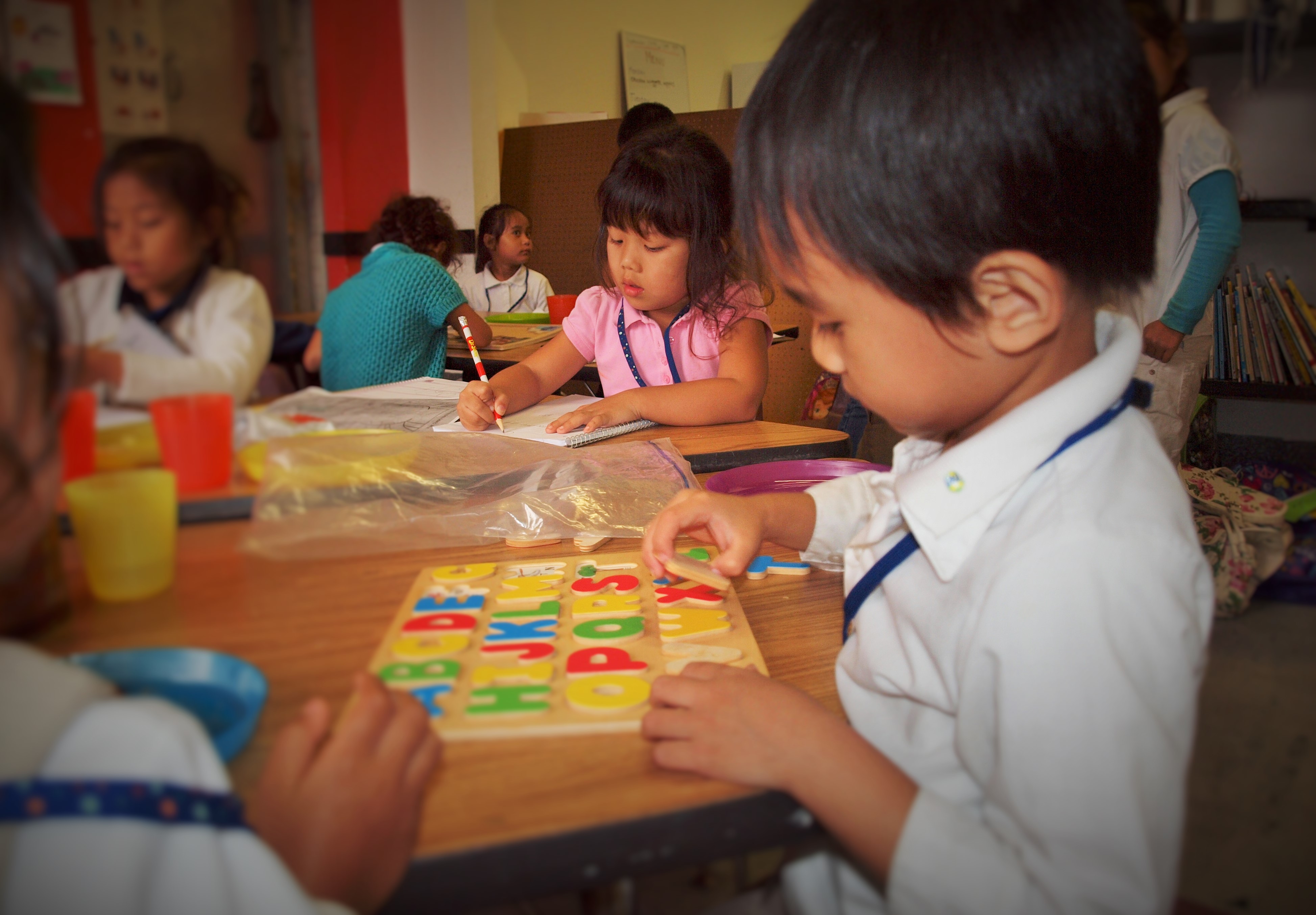
Kindergartners work on homework, have snacks, build puzzles and color during Our Bridge’s first hour. The program runs 3-6 p.m. Monday-Friday.

Kindergartners work on homework, have snacks, build puzzles and color during Our Bridge’s first hour. The program runs 3-6 p.m. Monday-Friday.

The classrooms are filled with puzzles and books, and there is a game center with dozens of board games.

The language lessons stick, Lang said, “when they learn by doing and having fun.”

Our Bridge also provides meals and transportation, celebrates cultural holidays and offers weekly learning themes. Through those themes, students engage in community outreach, physical activities, field trips and STEM-based learning.

Program Director Andrew Eastwood talked about a hit project on frog hibernation in which students made edible tadpole-winter hibernation exhibits of whipped cream, blue jello, chocolate pudding and gummy worms.

“The kids loved learning about it and eating it,” Eastwood said.

The Our Bridge program is at 1350 Central Ave. in Charlotte’s Central Square Shopping Center. The center has donated a grassy plot on the lot where the students plan a garden this spring.

Volunteer tutors worked with students at metal tables and chairs in classrooms, separated by brightly colored half-walls dividing them by grades.

Jack Meza, a volunteer tutor who emigrated to the U.S. from Ecuador 10 years ago, said, “When I came here, I didn’t speak English and I pretty much had to teach myself.

“I am here to help these students so they don’t have to face the same challenges I did.”

Phayel Bhagi, also a volunteer tutor, works as a classroom facilitator with Central Piedmont Community College’s Adult ESL program. Bhagi moved to Charlotte from Bhutan five years ago.

“I get energy from their excitement,” Bhagi said of the Our Bridge students, “and I love learning about their different languages.”

Billingsville student Yulissa Rojas Torres,10, attends Our Bridge. “I like the teachers here, and I like being with my friends.

“You have so much fun here,” she said.

Posted in Charlotte Observer, Education, Family and Parenting, Human Interest, Newspaper, Philanthropy, Traditional Journalism | Tagged , , , , | Leave a comment

Playground safety guarantees good time

Fulton & Barr: The Legal Pad
October 01, 2014

During this time of the year, humidity slowly moves out of the Carolinas and the scorching heat gives way to cool, warm afternoons. These weather conditions make playgrounds the ideal place to play.

https://www.flickr.com/photos/kagey_b/126586786/in/photolist-cbMQN-49mWXe-9AquTg-3JDbWM-a5Cv27-2zn88t-6S3X1n-6u1cJ6-5kZV5A-acf7vV-oK8zC-e8KP2Y-52UWBA-CBz7i-dUSBkR-m1UiRc-6pCwnY-7GnBoK-eixfxq-6pynxB-9Huxf-4bR3B1-8aCKU5-ashqyR-JQHeh-JsfjQ-7nnxd7-mP4c3g-5fCPyw-oyBYYu-yuv53-2tt6XP-dAEAEE-o9L9ZG-JSqt3-2U4xZ-aB9TAD-h3uUR-5goWhz-d3Asff-EuewF-7CSgWo-6h6ZmM-6qADCr-aaUEv-7iogSS-nPQkq-fMM4bU-eTdGn1-7mvtGK/

Children love making new friends or meeting up with old ones to swing and slide the hours away. Parents love it, too. They know it’s a great way for kids to get some physical activity outdoors and it gives them peace of mind – keeping their kids entertained.

Peace of mind, that is, if it’s safe.

According to WebMD, 200,000 children visit emergency rooms every year for playground-related injuries. The Centers for Disease Control and Prevention states that most injuries are not fatal. The most common injuries are concussions, dislocations, severe fractures and amputations. Between 1990 and 2000, 147 children died from playground injuries. These fatalities occurred primarily from falls and strangulation at home playground equipment.

While these stats are somewhat alarming, there are steps parents can take to make sure their home and favorite public playground equipment is safe.

The number one way to prevent most playground injuries is to survey the grounds where the play equipment is positioned. The American Academy of Pediatrics recommends that playgrounds sit on safety-tested mats or loose-fill materials, such as sand, shredded rubber, wood chips and bark. The protective surface materials should extend six feet from the structure in all directions and reach a depth of 9-12 inches. Avoid playgrounds on concrete, asphalt, grass and soil surfaces. The AAP states in an article on HealthyChildren.org that falling headfirst from playgrounds, even when they are just a few inches from the ground, can cause serious injuries.

Playground_pic1

Equipment should also be regularly checked for maintenance. Inspect playgrounds for rusted metal, sharp and exposed edges (nails, screws, etc.), damaged parts and splintering wood. Any broken or damaged parts should be replaced immediately or notify local authorities – for public play areas that could be Parks and Recreation officials, schools or businesses.

Also, consider becoming an advocate for playground safety. Contact your local representative and discuss the importance for regulating routine public playground safety inspections. Speaking up about safety always has the potential to save lives.

Currently, there are no state or national laws on the maintenance of public and private playground equipment; however, the responsible party/property owner can be held accountable for injuries due to negligence. These cases become more aggressively prosecuted when a child is injured because of unsafe conditions.

If your child is injured or killed from unsafe playground equipment, we can help.

Contact Fulton & Barr, Attorneys at Law today for your free initial consultation, (800) 868-2110.

Posted in Brand Journalism, Family and Parenting, Fulton & Barr: The Legal Pad, Health and Wellness, Law, Professional Blog | Tagged , , , | Leave a comment

Who knew getting hurt could be so hip?

Fulton & Barr, Attorneys  at Law
Fulton & Barr: The Legal Pad
Sunday, September 28, 2014

One Louisville work injury law firm achieves star status.

Winton & Hiestand Law Group enlisted A-list Rap Mogul and Founder of No Limit Records Master P to appear in their latest commercial. Obviously, this was an attempt to reach a younger, more hip audience.

The commercial and accompanying billboard and advertisements use Master P’s famous catchphrase “Make ‘em say Ughh!” as the symbolic sound of frustration to be made by the party at fault for the injury, when they lose the case and owe Winton & Hiestand’s clients for costs caused by the injury.

Credited to Winton & Hiestand.

This well-known lyric and song title is from Master P’s sixth album Ghetto D, which was released in September 1997. Master P is well-known for his graphic gangster rap lyrics that propelled his success in the 90’s and early 2000’s. Even though, he just released his thirteenth album, “The Gift” last year, Master P says he’s most successful as a businessman.

Master P said in an interview to VladTV, “I’m the best hustler in the game … I’m always about my business.”

Master P’s, whose real name is Percy Robert Miller, 2013 net worth was over 350 million dollars, estimated by Forbes Magazine. Given that, it’s doubtful that he pitched this commercial for profit.

According to TMC, the rapper became friends with the attorneys during the aftermath of Hurricane Katrina. Chauncey Hiestand said they got to know each other well when a lot of Miller’s friends moved from his hometown in Louisiana to Louisville, Kentucky.

The attorneys’ YouTube post of the commercial states that Miller began to visit the area and got involved with the local community. He founded Let The Kids Grow Foundation to help struggling youth in Louisville. The organization provides educational and creative arts programs, as well as hot meals and backpacks to area students. Miller believes in education as a game-changer for these kids and encourages them to stay off the streets and in school.

Winton & Hiestand said they worked with Miller on community projects. In return, Miller promoted their business, as a gesture of appreciation.


Fulton & Barr may not have a celebrity spokesperson, but just like Winton & Hiestand they believe in helping those who truly need it. So, if you or anyone you know gets hurt on the job, contact Fulton & Barr, Attorneys at Law. They will work tirelessly to ‘rap’ up the case in your favor.

Posted in Brand Journalism, Entertainment/Creative Arts, Fulton & Barr: The Legal Pad, Law, Philanthropy, Pop Culture | Tagged , , , | Leave a comment